
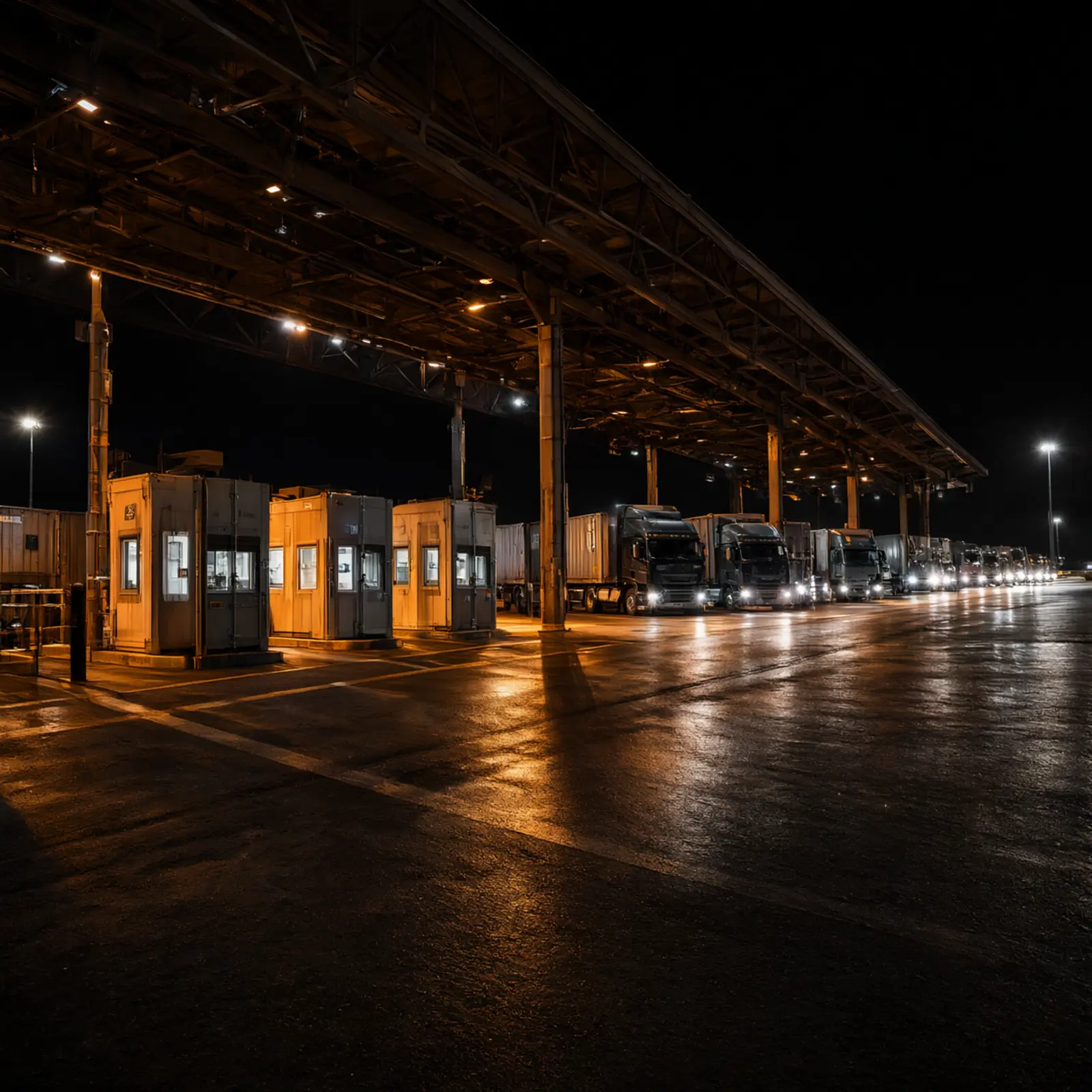
How a U.S.–Mexico truckload shipment actually moves
Most shippers can describe their domestic lanes precisely and their Mexico lanes vaguely. Here is what actually happens between the plant and the dock.
Ask a logistics manager to describe a Chicago–Dallas truckload and you will get a precise answer. Ask the same person to describe a Monterrey–Dallas truckload and the answer usually gets vaguer somewhere around the bridge. That vagueness is where the cost lives.
This is what actually happens, and where it goes wrong.
It is not one truck, and it is rarely one carrier
The single most useful correction to most people’s mental model is this: a cross-border truckload is normally performed by three different carriers, not one.
- A Mexican motor carrier runs the domestic leg from the origin to a yard near the border.
- A drayage carrier moves the trailer across the bridge. This is a short, specialised movement with its own operator and its own equipment permissions.
- A U.S. motor carrier picks the freight up on the north side and runs the linehaul to destination.
Southbound is the mirror image. Around those three sit a customs broker on each side, usually a transfer facility, and a documentation package that has to be complete before any of it is useful.
Each handoff is a scheduling dependency. If the drayage carrier is ready and the customs broker is not, the trailer waits. If customs is cleared and the northbound carrier was booked for tomorrow, the trailer waits. The freight does not sit because anyone is lazy; it sits because the sequence was never planned as a sequence.
Why your freight changes trailers
Mexican and U.S. carriers generally operate their own equipment on their own side. Through-trailer arrangements exist, but they are not the default on most lanes and they are not always cheaper.
So the freight is transloaded — physically moved from one trailer to another — at or near the crossing. This is routine and unremarkable. What is not routine is how badly it is often executed.
A well-run transfer also does something else: it records piece count and visible condition at the point where both parties are present. Catching a shortage at the border, while you can still do something about it, is materially better than discovering it at the receiver’s dock four days later with no way to establish where it happened.
Documentation is where shipments actually stop
It is tempting to blame delays on inspection. In practice, the shipments that sit are far more often sitting because a document did not add up.
The recurring offenders:
- A commercial invoice whose values or descriptions do not match the packing list.
- A description too vague to classify — “machine parts” is not a description.
- A piece count on the invoice that disagrees with the bill of lading.
- A certificate of origin or product permit that arrives after the broker needed it.
- A weight that does not match what is physically on the trailer.
None of these is difficult to prevent. All of them are expensive to fix once the equipment is at the bridge, because fixing them means someone has to reach the shipper’s finance department in the middle of an operational problem.
The discipline that works is dull: assemble the package against the shipment reference, check it for internal consistency, and get it to the customs broker before the truck leaves the origin — not before it reaches the bridge.
Who actually clears the shipment
A licensed customs broker files the entry. Not your freight broker, not your carrier, not the transfer yard. This matters when you are evaluating providers, because a provider who implies they “clear customs” is either a licensed customs broker or is describing coordination in misleading terms.
Customs coordination — which is what a freight broker can legitimately provide — means making sure the customs broker has a complete, consistent package inside their filing window, and sequencing the physical movement around it. That is a real service and it is worth a great deal. It is not the same as filing the entry.
Who is insuring the freight
This is the question most shippers answer wrong, and it is worth being blunt about.
The motor carrier carries liability for freight in its possession, subject to its own terms and limits. That is not a policy covering your goods at commercial value — it is a limited liability, and the two numbers frequently differ by a wide margin.
A freight broker’s surety bond does not insure cargo at all; it secures the broker’s performance of its transportation arrangements.
Mexico shipments must be insured by the customer unless cargo insurance is arranged by DCI Logistics LLC at the customer’s express request.
That is our position, stated plainly. If you want us to arrange cargo insurance, ask expressly — and understand that asking is a request. Cover exists once it is confirmed in writing, not before.
How long it takes, honestly
Anyone who quotes you a guaranteed crossing time is guessing. Crossing duration depends on the port of entry, the commodity, the day of the week, the time of day, whether the documentation is clean, whether the shipment is selected for examination, and conditions on the day.
What you can plan around is the shape of the movement: origin pickup, domestic linehaul, arrival at the border yard, transfer, customs window, onward linehaul, delivery appointment. Build the schedule from the delivery appointment backwards and you will make better decisions than by adding up optimistic transit estimates forwards.
What to fix first
If your Mexico lanes are underperforming, these are the highest-leverage things to look at, roughly in order:
- Is anybody accountable for the whole movement, or does each provider answer only for their leg?
- Is the documentation checked for internal consistency before the equipment moves, by someone whose job that is?
- Is the transfer a scheduled event with a time, or an assumption?
- Does your customs broker receive the package inside their filing window, reliably?
- Do you know, in writing, who is insuring the cargo?
- When something stops, how long does it take before a decision-maker at your company hears about it?
Five of those six are coordination problems, not transportation problems. That is the honest reason cross-border lanes underperform, and it is also why they are fixable.
How we operate
DCI Logistics LLC is a licensed property broker (USDOT 4303609 · MC-1676403). We arrange and coordinate transportation; the freight is physically transported by independent authorized motor carriers under their own operating authority and insurance.
See compliance informationCargo insurance — Mexico
Mexico shipments must be insured by the customer unless cargo insurance is arranged by DCI Logistics LLC at the customer’s express request.
Read the full notice