
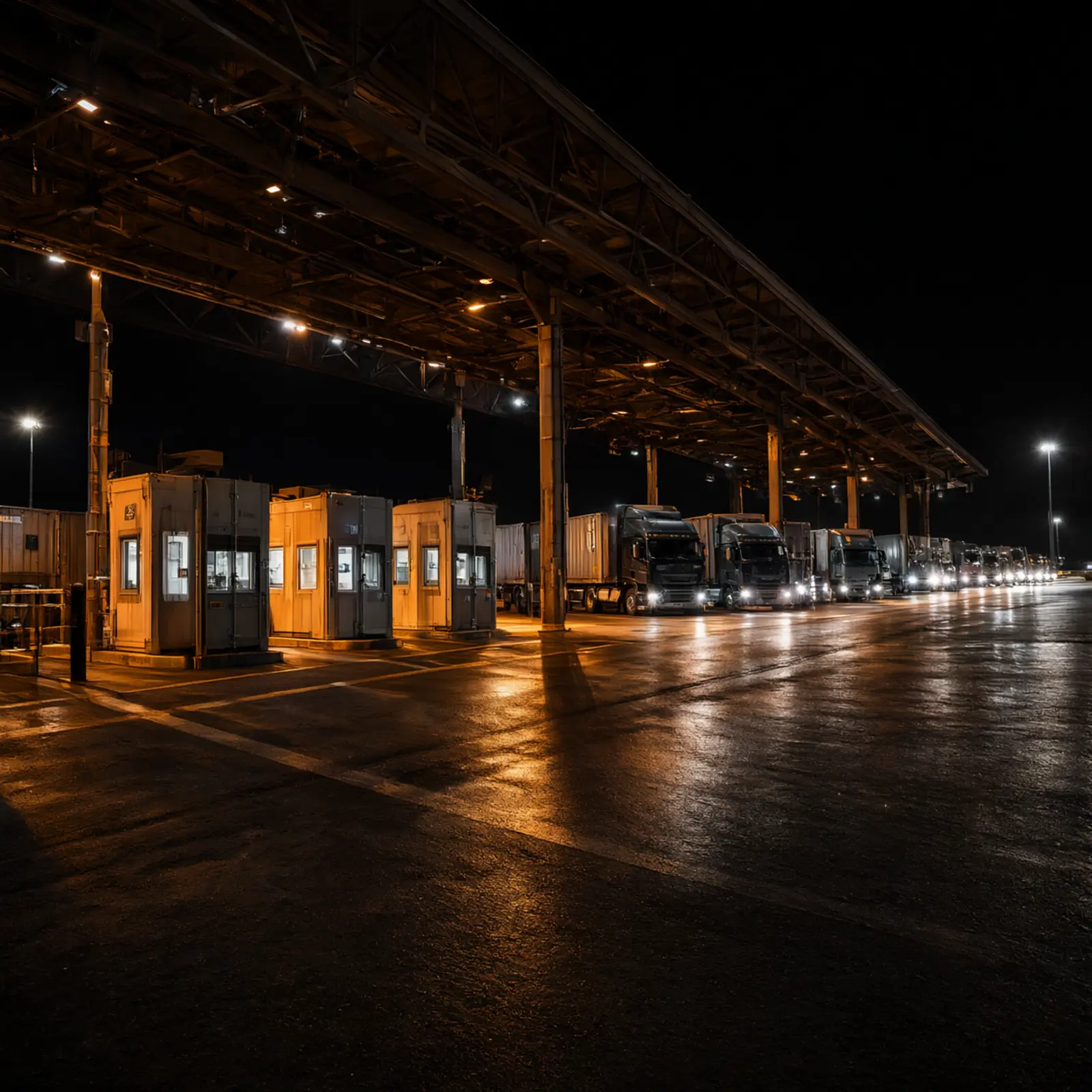
Cross-border · Mexico ↔ United States
Mexico ↔ United States
Mexico is the United States’ largest trading partner, and the overwhelming majority of that trade moves by truck. Almost none of it moves on a single trailer from origin to destination.
What actually happens at the border
A typical northbound movement involves at least three carriers: a Mexican motor carrier running the domestic leg to the border, a drayage carrier moving the trailer across the bridge, and a U.S. motor carrier taking it onward. Southbound is the mirror image. Between them sits a customs broker on each side, a transfer yard, and a documentation package that has to be right before any of it moves.
Every one of those handoffs is a place the shipment can stop. Our job is to make sure the handoffs are scheduled against each other rather than discovered in sequence — and that when something does go wrong, you hear about it from us before you hear about it from your customer.
- Domestic leg in Mexico with an authorized Mexican motor carrier
- Drayage across the bridge
- Transfer or transload at the crossing where the lane requires an equipment change
- Customs entry filed by the licensed customs broker on the relevant side
- U.S. linehaul with a vetted, authorized motor carrier
- Final-mile delivery to the receiver’s appointment
Documentation is the usual point of failure
In our experience the shipments that stall are rarely stopped by inspection — they are stopped because the commercial invoice disagrees with the packing list, a value is missing, a description is too vague, or a certificate arrived after the broker needed it.
We assemble the documentation against the shipment reference and check it for internal consistency before the equipment is anywhere near the bridge. It is a dull discipline and it is the single highest-leverage thing anyone does on this lane.
- Commercial invoice — values, descriptions and quantities consistent with the physical load
- Packing list — piece count and weights that match the bill of lading
- Bill of lading for each leg
- Certificates of origin and any product-specific permits
- Customs instructions delivered to the broker inside their filing window
Cargo insurance on Mexico movements
This one is worth reading carefully, because it is the point most often misunderstood.
Mexico shipments must be insured by the customer unless cargo insurance is arranged by DCI Logistics LLC at the customer’s express request.
If you would like us to arrange cargo insurance, say so explicitly — there is an option for exactly that on our quote form. Making the request is a request. Cover exists only once DCI Logistics LLC confirms it in writing. Nothing about selecting an option on a web form, by itself, places cover on your freight.
Where we coordinate
Our operating centre is Laredo, and the Laredo – Nuevo Laredo crossing is the corridor we work most. We also coordinate movements through other crossings where the lane calls for it. If your lane runs through a crossing not listed here, tell us — the question is whether the lane works, not whether it appears on a map.
Crossings
-
Laredo – Nuevo Laredo
Texas · Tamaulipas
The busiest inland port in the United States and our operating centre.
-
Otay Mesa – Tijuana
California · Baja California
The western gateway, serving southern California and the Baja manufacturing base.
-
El Paso – Ciudad Juárez
Texas · Chihuahua
Serving the Chihuahua and central-corridor manufacturing belt.
How we operate
DCI Logistics LLC is a licensed property broker (USDOT 4303609 · MC-1676403). We arrange and coordinate transportation; the freight is physically transported by independent authorized motor carriers under their own operating authority and insurance.
See compliance informationCargo insurance — Mexico
Mexico shipments must be insured by the customer unless cargo insurance is arranged by DCI Logistics LLC at the customer’s express request.
Read the full noticeFrequently asked
Does DCI Logistics operate trucks in Mexico?
No. DCI Logistics LLC is a licensed property broker registered with FMCSA (USDOT 4303609, MC-1676403). We arrange and coordinate transportation. Both the Mexican and the U.S. legs are performed by independent, authorized motor carriers operating under their own authority and insurance.
Who files the customs entry?
A licensed customs broker — not DCI. We provide customs coordination: assembling the documentation, getting it to the broker in time and sequencing the physical movement around their filing window. If you already work with a customs broker you trust, we coordinate with them.
Who is responsible for insuring the cargo?
Mexico shipments must be insured by the customer unless cargo insurance is arranged by DCI Logistics LLC at the customer’s express request. Requesting that we arrange it records a request; coverage exists only once we confirm it in writing.
Why does my freight have to change trailers?
Mexican and U.S. motor carriers generally run their own equipment on their own side of the border, with drayage moving trailers across. Transloading is how the freight continues without depending on a through-trailer arrangement that may not exist on your lane. We schedule the transfer as an event with a time on it.
How long does a crossing take?
It depends on the crossing, the commodity, the time of day, the completeness of the documentation and conditions on the day — and anyone who quotes you a guaranteed crossing time is guessing. What we commit to is planning the movement around the customs window and telling you promptly when something changes.
Ready to move?
Send us the lane. We will come back with a plan.